
Slab Cabinet Doors: Surface, Edge and Finish Options
How flat slab fronts are built, surfaced, and finished, and what that means for your kitchen in Northern Virginia

Sam K. · Showroom Manager
· 7 min read

A slab cabinet door is a flat, single piece front with no frame around it and no raised or recessed panel in the middle. Because there is no detail to look at, everything you notice about a slab door comes from three things: the surface material, the edge, and the finish. Get those right and a flat door looks calm and expensive. Get them wrong and the same shape looks like a rental. This is the conversation I have most often with homeowners who walk into our Alexandria showroom asking for a clean, modern kitchen.
I am going to keep opening mechanisms out of this, handles and push to open deserve their own article, and stay on the door itself: what it is made of, how its edges are treated, and how the finish behaves once it is living in your house.
What exactly is a slab cabinet door?
Think of a slab door as the opposite of a shaker. A shaker has a frame and a flat center panel. A slab has nothing but the flat face. That simplicity is the whole point and also the whole risk. With nothing to distract the eye, your attention goes straight to how flat the panel actually sits, how the color reads, and how the edges are finished. A good slab front is dead flat and stays flat, which is harder to build than it sounds, because a thin board can bow over a hot, humid Virginia summer if it is not engineered well.
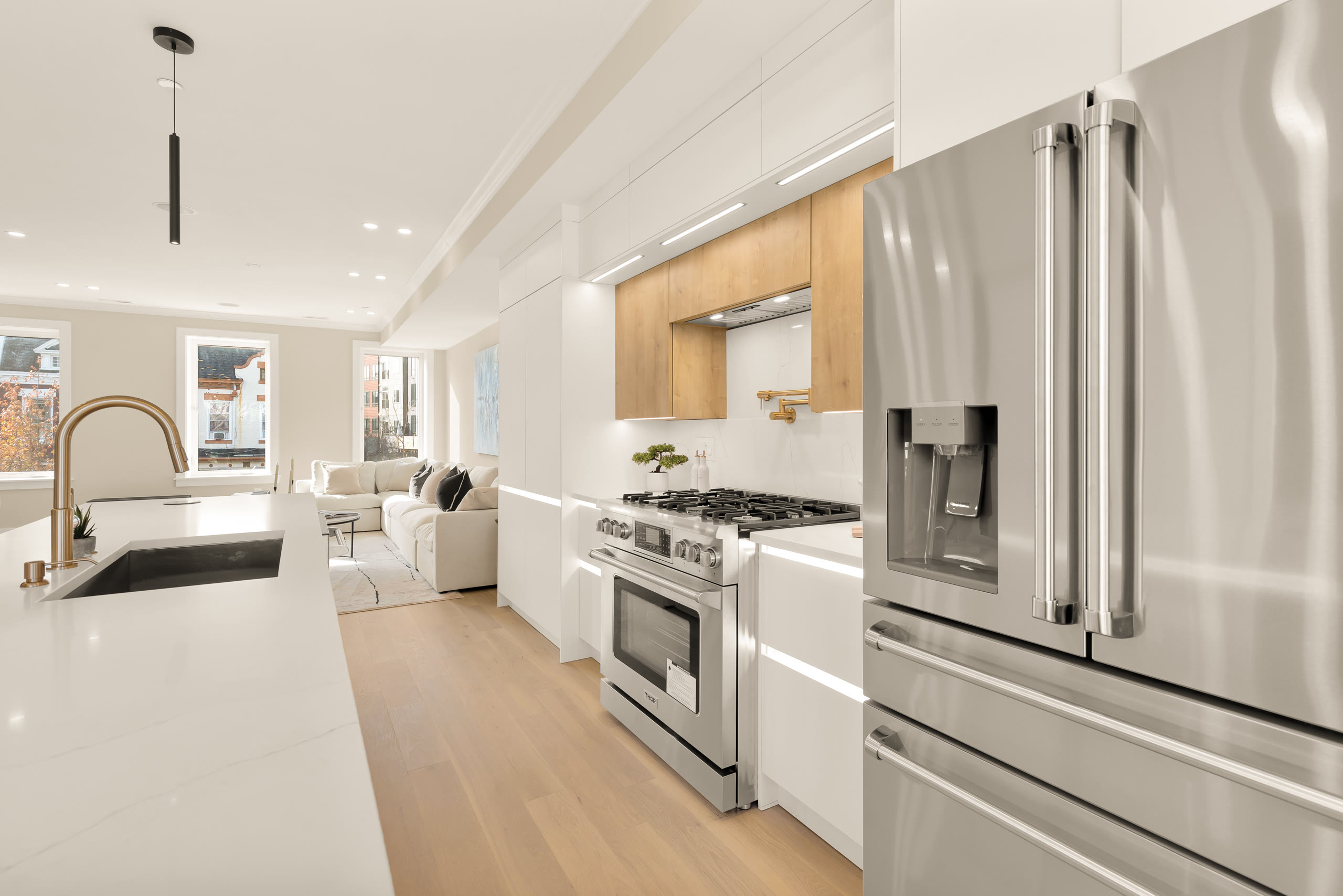
Most quality slab doors start with an engineered core, usually MDF or a stable board, because solid wood planks would move too much and the flat face would telegraph every seasonal shift. The core is not what you see. What you see is whatever surface is applied on top, and that is where the real decisions live. Our neoFLAT fronts are a straightforward example of this family: a flat slab offered in several surfaces, from lacquer to real oak, on a core built to stay true.
Which surface materials work best on a slab door?
There are three surfaces I walk clients through, and each one answers a different question.
Lacquer is a sprayed, painted finish. It gives you the deepest color and the truest gloss or matte surface you can get on a flat door. A matte lacquer in a soft greige or a warm white is probably the most forgiving luxury finish out there. A high gloss lacquer is stunning in the right light and demanding the rest of the time, which I will come back to. Lacquer costs more, and it is worth it when color depth matters to you.
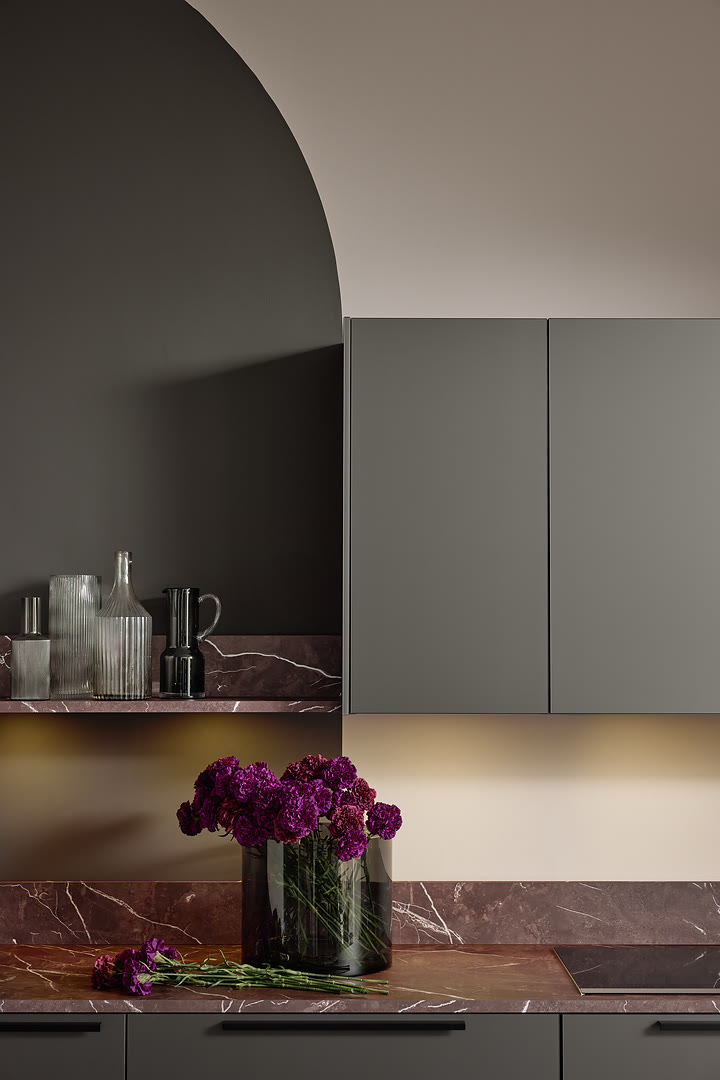
Melamine, sometimes sold as laminate, is a tough printed layer fused to the board under heat and pressure. It resists scratches and heat better than lacquer, costs less, and today the good ones reproduce wood grain and stone convincingly. I never apologize for melamine. For a busy family kitchen with kids, it is often the smarter choice, and nobody but a cabinet maker is going to run a hand across it and know.
Real wood veneer is a thin layer of genuine oak, walnut, or another species over the stable core. This is what you want when grain matters to you, because no print fully matches the depth of real wood catching the light. A flat walnut slab across a run of drawers is one of the quietest, richest things you can put in a kitchen. The trade off is that real wood varies board to board and asks for a little more care.
There is also texture, which cuts across all three. Fluted and grooved slab fronts have taken off, and they add shadow and depth to a flat door without breaking its clean line. If you like the slab look but find a perfectly plain run a little stark, a fine flute is a good middle ground.
Do slab doors need special edge details?
Yes, and this is the detail most people never think to ask about. On a shaker the frame hides the edge. On a slab the edge is right there on every door and drawer, and it is the first place a cheap door gives itself away.
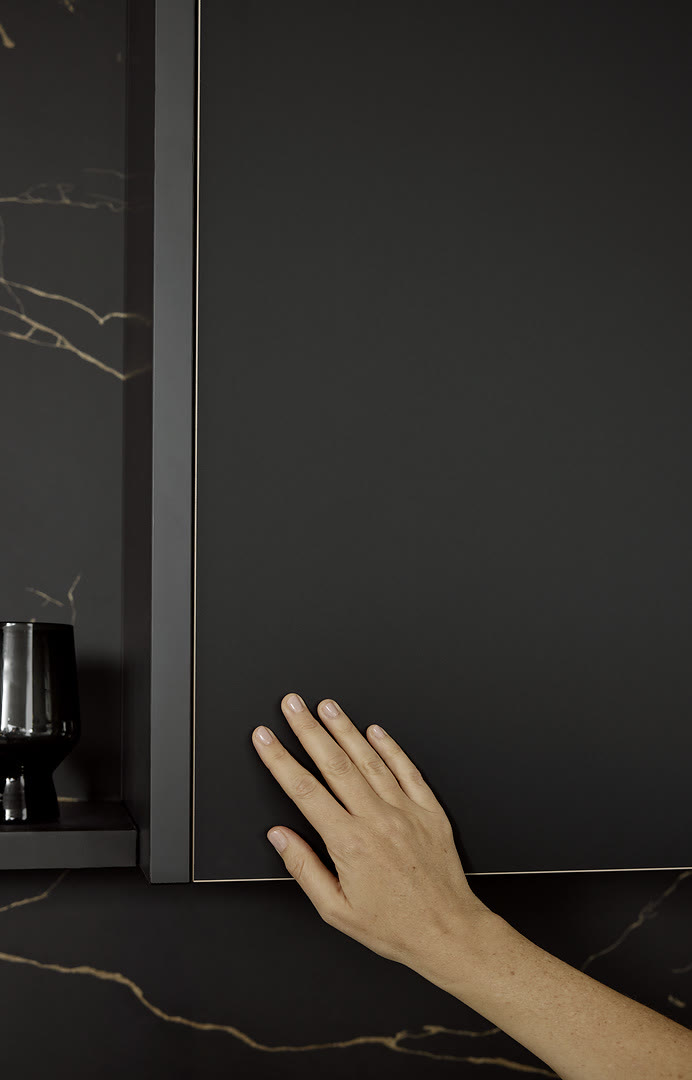
On a lacquered door, the lacquer wraps the edge so the whole face reads as one seamless piece. That is the premium look, and it is why a properly lacquered slab feels solid in the hand. On a melamine or veneer door, the edge is banded with a matching strip, and the quality of that banding is everything. A tight, color matched, laser bonded edge looks like part of the door. A thick glued strip with a visible seam looks like exactly what it is. When you are comparing cabinets, run your fingernail along the edge of a door. If you can feel and see the seam, keep shopping.
Some ranges add a thin metal trim along the edge as a design feature rather than just protection. It looks sharp in a dark, dramatic kitchen. It is a style choice, not a necessity, so treat it as seasoning, not the main dish.
How do slab finishes hold up day to day?
This is the question that should drive your finish choice more than color does, and it is the one people ask last. The short version: gloss shows everything, matte hides most of it, and texture hides even more.
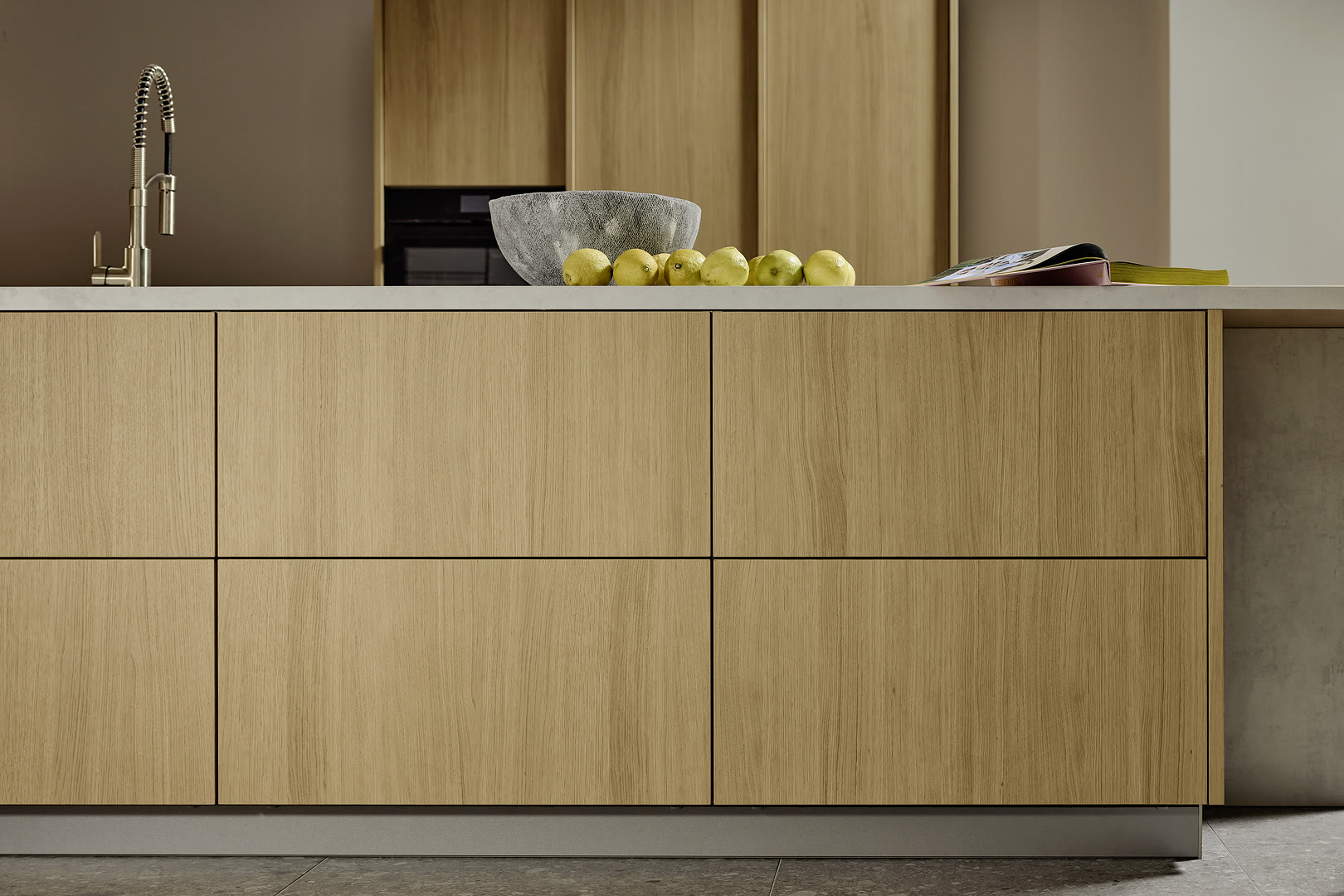
A high gloss lacquer is a mirror. It is gorgeous when it is clean and it will show fingerprints, water spots, and fine swirl marks from wiping. If you choose high gloss, go in knowing you will wipe it more often, and lean toward a lighter color where prints disappear faster. A matte lacquer or a soft matt surface is far more relaxed. It takes daily life without announcing it, which is why I steer most families toward matte. Melamine shrugs off the most abuse of the three. Real wood veneer sits in the middle, and the small marks it does pick up tend to blend into the grain rather than stand out.
Cleaning is simple across the board: a soft cloth and warm water for daily wiping, a mild cleaner for the occasional deeper clean, and nothing abrasive, ever. Abrasive pads are what dull a finish and leave the swirls you cannot undo. One honest warning for our climate: on cabinets right beside an oven or a steam heavy cooktop, keep a flat front wiped dry, because standing heat and moisture are what shorten the life of any edge over the years.
If you want to go deeper on how these flat fronts compare to framed American boxes, I wrote about that in our piece on frameless European versus framed American cabinets. And if you are drawn to the look but want to mix a couple of finishes, our notes on two tone cabinets and on high gloss versus matte white both get into the trade offs in more detail.
How should you actually choose?
Order real samples and live with them. A finish that looks perfect under showroom lighting can read completely different in a north facing Northern Virginia kitchen in January. Tape the samples to your cabinets, look at them morning and night, and wipe a fingerprint across the gloss option before you commit. The flat slab door is the easiest profile to love and the easiest to get slightly wrong, and the difference is almost always in the surface, the edge, and the finish rather than the shape itself.
If you want to hold the actual samples side by side and see them on finished cabinets, come see us. You will leave knowing which surface suits how you cook, not just which one photographs well.
Frequently Asked Questions
Are slab doors more modern than shaker doors?
Do slab cabinet doors scratch easily?
What is the difference between lacquer and melamine on a slab door?
Can I get a wood grain look on a flat slab front?
Will fingerprints be a problem on dark slab doors?
Keep Reading

Frameless European vs. Framed American Cabinets in 2026
The real difference between frameless European and framed American cabinets, and how each one holds up in a Northern Virginia kitchen.

Two-Tone Kitchen Cabinets: How to Pair Upper, Lower and Island
A practical guide to pairing upper, lower, and island colors in a two-tone kitchen, with wood-and-painted combinations and sample testing tips.

Walnut Kitchen Cabinets: Grain, Finishes and Countertops
How to choose walnut kitchen cabinets: reading grain and tone, veneer versus solid wood, and the countertops that pair with Walnut Rosado and Havana.
Ready to talk through your remodel?
Visit our showroom or request an estimate. We will walk you from first ideas to final installation.